
Someone types a question into Google, reads the answer at the top, and closes the tab. No click, no visit, no new lead for whoever wrote the page that answer came from. That is now the most common outcome on Google.
The Numbers Behind the Shift
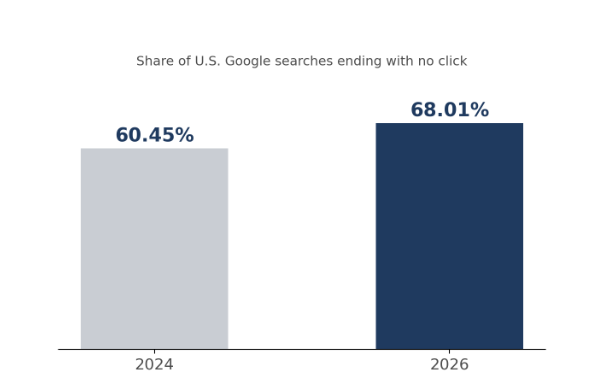
A study from SparkToro, using Similarweb clickstream data, found that 68.01% of US Google searches ended without a click between January and April of 2026. That is up from 60.45% in 2024.
AI Overviews are a big part of the reason. They now show up more than 20% of Google searches, and when one appears, SparkToro found click-through rates drop by close to 60%.
A separate study backs up with a controlled experiment. Researchers Agarwal and Sen randomly showed AI Overviews to some searchers and not others over two weeks in early 2026. The group that saw AI Overviews clicked on organic results 38% less, and their zero-click rate jumped from 54% to 72%.
It’s Worse on Mobile
Desktops and mobile do not look the same here. Zero-click search is noticeably more common on phones than on computers, and most Google searches now happen on mobile. If a business’s audience skews toward mobile, the real zero-click rate they are dealing with is higher than any headline figure suggests.
What This Means for Businesses
A drop in organic traffic does not automatically mean a business is doing worse at SEO. It might mean Google is answering more questions before anyone reaches the website at all.
That changes what organic traffic even measures. A blog post that ranks well but gets fewer clicks may still be doing its job: informing an AI answer, building topical authority, or showing up in a citation, even when the visit itself never happens.
It also means fewer questions are worth writing content for. If a search can be fully answered in two sentences, no page is going to out-compete that with clicks.
What to Do About It
Stop treating clicks as the only signal
Impressions, brand mentions inside AI answers, and direct traffic all matter more than they used to. A page can be doing real work even when its click count looks flat.
Go after questions that need more than a summary
Anything that needs a real decision, a comparison, a local recommendation, or a demonstration is harder for an AI Overview to fully answer. That is where a website still earns the click.
Track branded search alongside organic clicks
If someone reads an answer, remembers the brand, and searches for it by name later, that shows up as a branded search, not an organic click. Watching that number can reveal traffic a standard report misses entirely.
The Bigger Picture
Search is not disappearing. It is split into two different jobs. One job is answering simple questions on the spot. The other is helping someone make a bigger decision. Most businesses are still set up to win the second job. The trouble is a lot of content was written for the first one.
Rohring Results has been adjusting client SEO strategy around this shift, building content meant to earn a citation and a decision, not only a click.