
A federal judge just decided how much Google has to change the way it runs online advertising. The answer: less than the government wanted, but more than nothing.
What Happened
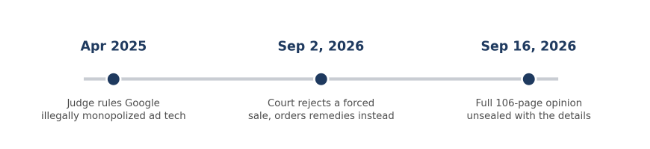
On September 2, US District Judge Leonie Brinkema rejected the Justice Department’s request to force Google to sell off parts of its ad tech business. She chose behavioral remedies instead, meaning Google keeps its ad exchange but has to change how it runs it.
The full opinion explaining those remedies stayed sealed for two weeks. It came out on September 16, laying out exactly what Google now has to do.
Behavioral vs. Structural, in Plain Terms
Structural remedies force a company to sell or spin off part of a business. Behavioral remedies leave the business intact and put rules on how it can act going forward. The Justice Department wanted the first option. The court chose the second.
What Changes
- Prebid, an open-source header bidding tool, can now bid in real time on Google’s ad exchange
- Publishers get detailed data on ad auction bids from Google’s own ad server
- Google’s AdWords can no longer bid directly inside the publisher ad server the way it used to
The remedies last six years (the Justice Department had asked for fifteen) and apply worldwide, not only in the US. A monitor, a technical committee, and an internal compliance officer will track whether Google follows through, all paid for by Google.
Why the Judge Went This Way
This isn’t Google’s first brush with a possible breakup. A separate case over its search business ended the same way last year: real findings of wrongdoing, but no forced sale. Judge Brinkema had already ruled in April 2025 that Google broke antitrust law by controlling too much of the ad tech stack. What remained was deciding what to do about it, and she decided a forced sale wasn’t the answer.
Google agrees with the outcome, but not with everything in the opinion. The company says it will appeal to the part tied to its Ad Manager tool.
Who This Affects
Any business running ads through Google’s ad exchange, or any publisher selling ad space through Google’s tools, is affected here. Header bidding platforms like Prebid stand to gain real leverage they didn’t have before. Publishers get more visibility into how their own inventory gets priced.
For most small businesses running search or display ads, the day-to-day experience of buying ads through Google won’t change right away. The bigger shift is behind the scenes, in how the auction itself works and who gets to see inside it.
What to Watch
Google has said it will appeal, and that process could take years and could soften or delay some of these remedies. Also worth watching whether publishers put the new auction data to use, and whether Prebid’s wider access changes pricing in any real way.
None of these rewrites how digital advertising works overnight. It does mark one of the clearest lines yet drawn around how much control one company can have over the pipes that ad dollars flow through.
Rohring Results keeps an eye on changes like this, because programmatic advertising rules shift the playing field for every business buying ad space, not only the biggest ones.