
For years, the deal between Google and the websites it indexes has been simple. Google sends traffic, and a publisher earns money from that traffic through ads, subscriptions, or sales. Now, for a small group of publishers, that deal has a second part. Google will pay them directly, not for a click, but for showing up inside an AI answer.
What’s New
On September 14, Digiday reported new details on something Google had been quietly testing since earlier this year. Called the AI contribution pilot, it pays select publishers when Google decides their content meaningfully helped generate an answer inside AI Overviews, AI Mode, or Gemini.
Publishers in the pilot see a monthly earnings number inside a new “AI contribution” panel in Search Console. There is no breakdown of which articles earned what, or exactly how the number was calculated. Payments are based on Google’s judgment of a piece of content value to an answer, not on how often it was used.
How We Got Here
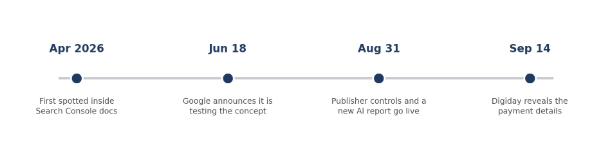
The pilot did not appear overnight. References to it showed up in Search Console documentation as early as April. Google confirmed it publicly on June 18, in a post about testing new ways to work with sites whose content helps keep AI answers fresh and accurate. By August 31, Google had rolled out separate tools letting site owners’ control whether their content is even eligible to ground AI answers, alongside a new report showing impressions from AI Overviews and AI Mode.
The September 14 report added the piece that was missing: money.
Where This Fits Among Google’s Publisher Deals
Google already runs a few programs that pay publishers directly. The News AI pilot covers more than 200 publications. Extended News Previews pays over 5,500 European publishers for how their content appears in search, including AI features. Google News Showcase pays more than 2,800 partners across 33 countries.
The AI contribution pilot is smaller and newer than all of them. Digiday found that dozens of publishers have been approaching so far, and it has landed better with small and mid-sized publishers than large ones. Participation is not limited to news organizations either.
Why It’s Drawing Criticism
Publishers can opt out at any time, and Google frames this as an early-stage pilot meant to test how to reward good content on top of the traffic and tools it already provides. Critics see it differently. Reporting on the pilot describes it as looking more like protection against legal and reputational risk than a meaningful new revenue line for publishers.
Part of the concern is transparency. A publisher can see a monthly number, not which articles drove it or how Google weighed their contribution. That makes the payment hard to negotiate around, since there is little a publisher can point to and ask for more of.
What Publishers Should Do
If invited, joining costs nothing, and the attribution runs through an account publishers already have in Search Console, so there is no new integration to build. The realistic expectation should be small. Early payouts are reportedly modest next to advertising revenue, and there is no guarantee the pilot expands or improves its reporting over time.
The more useful thing to track is the precedent, not the payout. This is the first time Google has offered money instead of traffic for AI use of a publisher’s content. Whatever comes next in this space will likely be compared to how this pilot played out.
What Businesses Should Take from This
Even for a business that is not a publisher chasing this specific program, this points something bigger: the value of a website’s content is starting to get priced in more than one way. A page can earn a visitor, a citation, or now, a small direct payment for showing up in an answer. None of these fully replace the others yet.
Rohring Results is watching how these programs develop, because they are an early sign of how content might get valued once clicks are no longer the only currency search runs on.