
A marketing manager used to open a dashboard, look at performance, and decide where to move the budget. Increasingly, that decision happens before anyone opens the dashboard at all. An AI agent makes the call and posts the update straight into a Slack channel.
What’s Happening Right Now
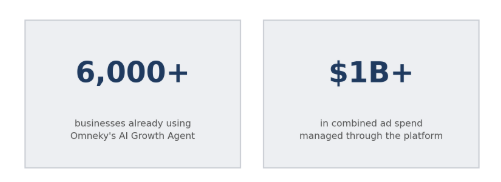
On September 17, Omneky, an AI advertising platform used by more than 6,000 businesses managing over $1 billion in combined ad spend, added a Slack integration for its AI Growth Agent. The agent doesn’t only flag underperforming ads. It launches campaigns, moves budget toward what’s converting, and posts pacing updates straight into a company’s Slack channel. A person still signs off on the biggest moves, but the agent now handles the analysis, the decision, and the execution, not only the reporting.
Other platforms are moving in the same direction, though not all at the same speed.
Meta AI: analyzes, but doesn’t act
In August, Meta connected its AI assistant to a business’s Facebook and Instagram accounts, Meta Ads data, and Google Workspace (Gmail, Docs, Sheets, and Slides). It can review performance, draft recommendations, and turn that into reports and documents. It does not make changes on its own. A person still has to act on whatever it suggests.
Google Ask Advisor built to go further
Introduced at Google Marketing Live 2026, this Gemini-powered agent works across Google Ads, Analytics, Merchant Center, and Marketing Platform. It can pull data, spot a problem such as a drop in impression share, and in some cases carry out the fix itself.
TikTok Agentic Hub: opening the door to outside agents
Launched in July, this is a marketplace of AI tools that let outside AI agents create, manage, analyze, and optimize TikTok ad campaigns directly, inside the tools a business already uses.
Not Every “AI Agent” Does the Same Job
It helps to split these into two groups. Meta AI works like an analyst: it looks at the numbers and tells a person what to do. Omneky and Google Ask Advisor work more like an operator: they can make the change themselves, sometimes with a person’s sign-off first.
That difference matters more than the label “AI agent” suggests. A tool that only recommends carries a different kind of risk than one that spends money on its own.
What This Means for Marketing Teams
The job is shifting. A marketing team used to manage campaigns. Now it often manages an agent that manages campaigns.
There’s a real upside. An agent can react to a shift in performance at two in the morning, something no team is staffed to do around the clock. It can test more variations, faster, than a person clicking through an ads dashboard ever could.
There’s also a real risk. Budget can move before anyone reviews the reasoning behind it. Brand voice and judgment calls that don’t show up cleanly in a conversion number are exactly what an agent optimizing for short-term performance can miss.
How to Use This Without Losing Control
Set a spending limit before turning an agent loose
Decide what dollar amount, or what type of action, needs a person’s sign-off, instead of finding out the limit after something goes wrong.
Check the agent’s reasoning, not only the result
A campaign that did well after an automatic change is worth understanding, not only accepting. The reasoning behind a good result this month is what protects against a bad one next month.
Keep a person on anything brand-sensitive
Budget shifts and bid changes are reasonable to hand off. Messaging and creative direction still benefit from a person’s judgment.
Marketing is moving from a place where AI helps a person decide, to one where AI decides and a person checks the work. That’s not a reason to slow down. The businesses using these tools well are already moving faster than the ones reviewing every ad by hand. It is a reason to be clear about where that oversight sits.
At Rohring Results, we build these kinds of checks into how we manage paid media for clients: using automation to move faster without losing the judgment calls that protect a brand.